New Zealand Online Gambling Reform 2026–2027: How the Market Changes for Players and Operators
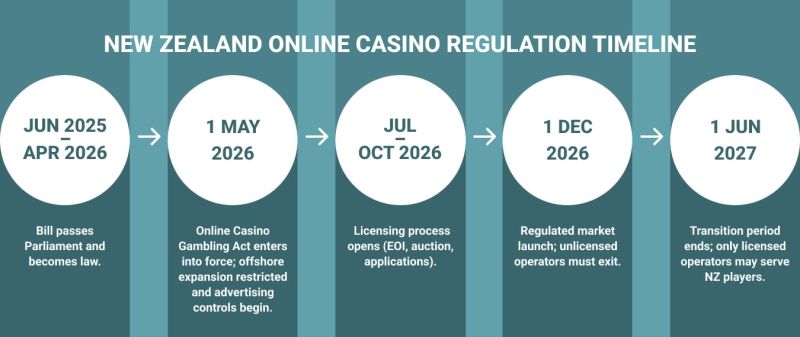
On 1 May 2026, the Online Casino Gambling Act 2026 (Public Act 2026 No 14) came into force, the largest change to New Zealand's gambling legislation since the Gambling Act 2003. For the first time, online casinos will operate under a domestic licence rather than in an offshore grey zone. The Department of Internal Affairs (DIA) will issue a maximum of 15 licences through a competitive auction. Under the Act, providers that have not applied for a licence must cease operating in New Zealand from 1 December 2026, and from 1 June 2027 only licensed operators will be permitted to serve Kiwi players — unlicensed sites will have to exit.
This guide covers the reform timeline, the tax structure, new player protections (deposit limits, a credit card ban, self-exclusion), the advertising rules that prohibit performance-based affiliate marketing, and where the NZ$700–800 million market is heading by 2027.
Why New Zealand Is Regulating Online Casinos
Until May 2026, the law sat in an unusual position: running an online casino from within New Zealand was illegal, while playing on offshore sites remained legal for residents. The result was a market without domestic oversight: no local licence, no dispute resolution, no payout guarantees, and roughly NZ$10 million in player losses flowing offshore every week.
Two datasets explain the government's urgency. On the GST side, Inland Revenue records showed 36 offshore operators voluntarily registered and paying the tax, with 15 of them accounting for more than 90% of the total collected. On the gambling-duty side, only 26 entities were registered in the year to 30 June 2025, declaring NZ$520.8 million in duty-liable gross gambling revenue and paying NZ$62.5 million in duty, the top five accounted for 89.6% of that declared figure. The actual market, including operators paying nothing, is estimated at NZ$700–800 million, and some industry estimates exceed NZ$1 billion.
The policy model is channelisation: the share of gambling activity that takes place on licensed platforms rather than illegal ones. Instead of prohibition (Australia's approach, where the illegal offshore market reached A$3.9 billion in 2024), New Zealand expects a competitive licensed market to draw players into an environment where harm-minimisation rules apply in practice. The UK and Ontario use the same model. Internal Affairs Minister Brooke van Velden has stated the goal plainly: not to grow online gambling, but to let New Zealanders play casino games more safely.
The reform runs in parallel with another structural shift. In June 2025, an amendment to the Racing Industry Act made TAB NZ the sole legal provider of online sports and race betting. Casino games now follow the same path from grey market to controlled access, with 15 operators instead of one.
Reform Timeline: 2025–2027
|
Date |
Event |
|
29–30 June 2025 |
Online Casino Gambling Bill introduced to Parliament |
|
July 2025 |
First reading passes 83 votes to 39 |
|
3 March 2026 |
Second reading passes |
|
23 April 2026 |
Third and final reading passes |
|
27 April 2026 |
Royal Assent — the bill becomes the Online Casino Gambling Act 2026 |
|
1 May 2026 |
Act in force. New offshore entrants prohibited, advertising ban with penalties up to NZ$5M, takedown powers active |
|
2 June 2026 |
Online Casino Gambling Regulations 2026 made by Order in Council |
|
3 July 2026 |
Regulations in force: harm prevention, consumer protection, advertising, fees and levies |
|
17 July 2026 |
Expressions of Interest opened via GETS and closed on 14 August 2026 — NZ$19,000 fee (excl. GST) per brand |
|
September 2026 |
Per DIA schedule: licence auction — ascending clock format |
|
October 2026 |
Per DIA schedule: successful bidders submit full applications, due by 1 December |
|
1 December 2026 |
Date fixed in the Act: operators without a pending application will have to exit, those with an application under consideration may keep operating without advertising |
|
1 January 2027 |
Date fixed in the Act: online gambling duty set to rise from 12% to 16% of GGR |
|
After licences are granted |
Licensed operators may begin advertising |
|
1 June 2027 |
Date fixed in the Act: transitional relief expires, only licensed operators will be permitted to serve NZ players |
|
~2029 |
Planned: three-year operational review of the regime, a requirement built into the legislation |
The transition is staged on purpose. Operators already serving New Zealand customers may continue under transitional arrangements until 1 December 2026, and their compliance behaviour during this window will be considered in the licensing process. For an operator weighing whether to keep running aggressive promotions through 2026, the calculation is direct: a violation now can cost a place at the auction later.
How the 15-Licence Auction Works
The Act caps the market at 15 licences, awarded through a three-stage process run by the Secretary for Internal Affairs. Every stage runs through the Government Electronic Tenders Service (GETS). Each licence covers a single brand, is valid for up to three years, and can be renewed once for up to five more. Licences are non-transferable.
-
Stage 1 — Expression of Interest (17 July to 14 August 2026, closed)
Applicants pay NZ$19,000 (excluding GST) per brand and disclose their ownership structure, key officers, financial capability, technology platform, branding and regulatory compliance history. Probity checks focus on offences involving dishonesty and on access to capital, with applicants required to show access to at least NZ$7.5 million. A separate EOI is required for each brand, so an operator seeking three licences pays the fee three times. The EOI window closed on 14 August 2026.
-
Stage 2 — Auction (from September 2026)
Entities that clear the EOI screen proceed to an ascending clock auction: the price rises in steps, all participants receive the same price simultaneously, and bidders withdraw as it climbs until demand matches the 15 available licences. At each price step every participant is offered the same price and decides whether to stay in or withdraw.
There is no obligation to grant all 15, if bids are weak, the government can issue fewer. No single entity may hold significant influence (20% or more of voting power or securities) over more than 3 licences, which blocks consolidation through shell structures.
A price-only allocation is rare: most regulated markets (the UK, Malta, Ontario) license any operator that meets the standards. Scarcity of 15 slots against a grey market of several hundred brands means the licence cost becomes a fixed barrier that only operators with substantial existing NZ revenue can recover.
-
Stage 3 — Licence Application (from October 2026)
Auction winners submit a business plan covering harm minimisation, advertising strategy, consumer protection, financial projections, and the platform and branding intended for the New Zealand market. Applications are due by 1 December 2026.
-
Who Is Expected to Bid
Operators that have publicly signalled intent include SkyCity, bet365, Super Group (owner of Betway and Spin) and Entain, the operating partner of TAB NZ, whose CEO Stella David reiterated at its August 2026 half-year results that it is targeting three of the 15 licences. SkyCity earlier lobbied for just 5 licences restricted to operators with a domestic presence, and TAB NZ also opposed the open 15-licence model, both lost that argument. Analysts at Jarden forecast annual gross gambling revenue of NZ$650 million if all 15 licences are issued, with NZ$474.5 million left after a combined tax burden of about 27% including GST — the revenue pool the bidders will be pricing against. That 27% is based on the current 12% duty. Once the duty rises to 16% in 2027, the combined load reaches about 31%.
Taxes and Levies for Licensed Operators
|
Charge |
Rate |
Applies from |
|
GST |
15% |
Already payable |
|
Online gambling duty |
16% of Gross Gambling Revenue (raised from 12%) |
1 January 2027 |
|
Problem gambling levy |
1.24% of gambling profits |
Payable by licensed operators |
|
General licensing levy (per the 2026 Regulations) |
3.5% of online gambling profits, quarterly |
Payable by licensed operators (regulations in force 3 July 2026) |
|
EOI fee |
NZ$19,000 (excl. GST) per brand |
17 July 2026 |
Community funding caused the loudest political fight. Pub and club gaming machines must return at least 40% of gross profits to community purposes, roughly NZ$300 million a year for grassroots sport and charities. Of more than 5,000 public submissions on the bill, 3,966 raised concerns that online migration would erode this funding, and over 50 sporting bodies, including rugby, football and cricket organisations, warned the loss to community sport could exceed NZ$150 million. The compromise: licensees make no direct community returns, but the 4 percentage points added to the duty (the rise from 12% to 16%) are ring-fenced for community causes and distributed by the Lottery Grants Board. Critics, including the Problem Gambling Foundation, argue this is insufficient and that the reform mainly benefits offshore operators.
Player winnings remain untaxed in New Zealand, the entire fiscal burden sits with operators.
What Changes for Players from December 2026
From 1 December 2026, providers that have not applied for a licence must stop serving Kiwis, while those with an application under consideration may keep operating without advertising until it is decided or 1 June 2027, whichever comes first. One legal nuance matters: the offence sits with operators, not players. A resident who gambles on an unlicensed site commits no offence, which is why officials concede a black market may persist. The DIA is required to maintain a public register of licensed operators, and checking it before depositing will be the simplest way to confirm a site's status once the list is published.
Mandatory Protection Tools on Licensed Sites
The Online Casino Gambling Regulations 2026 (in force 3 July 2026) require tools that most offshore sites do not offer today.
|
Requirement |
Detail |
|
Spending and time limits |
Daily, weekly or monthly caps on playtime, deposits and total spend, prompted at sign-up and monthly thereafter |
|
24-hour cooling-off |
Raising or removing a limit takes effect only after a mandatory 24-hour delay |
|
Breaks in play |
Operators must let a player set a break of at least 5 minutes after 60 minutes of continuous play, along with time-outs and pop-up alerts |
|
Self-exclusion |
Time-outs and exclusion options, including indefinite, operators monitor for problem-gambling signs and can exclude a player for up to 2 years |
|
Payment restrictions |
Credit card and buy-now-pay-later deposits banned |
|
Product controls |
Autoplay prohibited, only one slot game (pokie) may run at a time |
|
Bonus caps |
Rewards and inducements limited to NZ$100, or the lesser of NZ$100 and 200% of the deposit |
|
Age and identity checks |
18+ verification aligned with AML/CFT due diligence standards |
|
Complaints path |
A dispute resolution process and the right to complain directly to the New Zealand regulator |
The 24-hour delay deserves a note on mechanics: it converts a limit change from an in-session impulse into a decision made the following day, which is the point at which most loss-chasing behaviour cools off. The bonus cap works against a different pattern — offshore welcome packages of 200% up to several thousand dollars carry wagering requirements that make withdrawal unrealistic, and capping inducements at NZ$100 removes the bait entirely.
Fewer Brands, Enforceable Payouts
Choice narrows. A player in New Zealand can reach hundreds of offshore brands, and from December 2026 the market narrows to operators with a licence application under consideration. Once licences are granted, it is capped at 15 brands. In exchange, every licensee carries financial vetting, payout obligations enforceable in New Zealand, and AML supervision: licensees become reporting entities under the AML/CFT Act 2009.
For Kiwi punters currently using offshore platforms, the practical steps before December 2026 are short. Withdraw balances from operators that have not publicly committed to seeking an NZ licence. Complete KYC early, before verification queues build near the deadline. Once the licence list is published, check the DIA register before depositing. Sites that keep serving New Zealand after the cut-off operate illegally, with no recourse for players.
Advertising Rules: Affiliate Marketing Banned
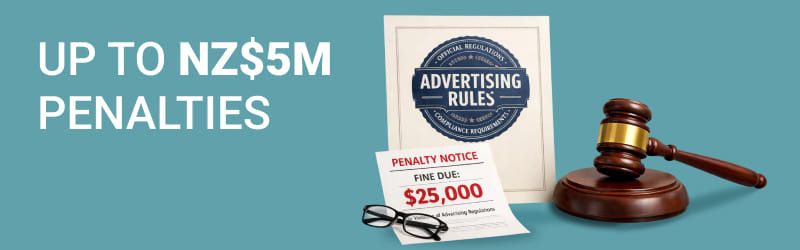
From 1 May 2026, advertising unlicensed online casino gambling is prohibited. The DIA can issue takedown notices and seek penalties of up to NZ$300,000 for individuals and NZ$5 million for companies, up from a previous maximum of NZ$10,000, and the powers apply extraterritorially, including against social media platforms that carry the ads. The regulator has already used its existing tools: in late 2025 it fined four social media influencers and an offshore operator a combined NZ$125,000 for illegal promotion.
Licensed operators may advertise only after their licence is granted. Even then, the restrictions remain tight:
- Performance-based affiliate arrangements are prohibited under the advertising provisions of the Online Casino Gambling Regulations 2026, in force since 3 July 2026.
- Paid endorsements and sponsorship-style promotions are banned, closing the influencer channel.
- No advertising placed where under-18s could make up more than 20% of the likely audience, and none directed at people aged 18 to 25 unless the operator takes reasonable steps to keep under-18s from seeing it.
- Advertising of slot jackpots is prohibited, along with images of physical gaming machines and poker chips.
- No ads during, or within 30 minutes before and after, live broadcasts, none on front pages of print publications or on public transport.
- Inducement advertising only under strict controls, no personalised ads designed to increase spend, no cross-promotion of other gambling products.
- Direct marketing requires express consent, with frequency settings controlled by the player.
For the marketing ecosystem built around the grey market — affiliate sites, streamers, tipster channels — the licensed NZ market closes to performance-based referral deals, endorsements and sponsorships. Licensees will compete on product and trust rather than promotional volume.
New Zealand vs Other Regulated Markets
|
Jurisdiction |
Model |
Licence cap |
Online casino tax (GGR) |
|
New Zealand (2026) |
Licensed, auction-based |
15 |
16% duty + 15% GST + 1.24% levy |
|
United Kingdom |
Licensed, open |
None |
40% remote gaming duty (raised from 21% on 1 April 2026) |
|
Ontario, Canada |
Licensed, open |
None |
20% revenue share |
|
Australia |
Online casino prohibited |
0 |
— |
|
Sweden |
Licensed, open |
None |
22% |
The design is a hybrid: more open than Australia's prohibition, more restrictive than Britain's open licensing. The tax picture shifted in 2026. After the UK nearly doubled its remote gaming duty to 40%, with a 25% remote betting duty arriving in April 2027, New Zealand's combined load of roughly 31% across GST, duty and levies now sits mid-range rather than at the heavy end. The cap of 15 remains the most distinctive feature, and the three-year operational review written into the Act will be the first formal test of whether scarcity helped or hurt channelisation.
Market Outlook to 2027
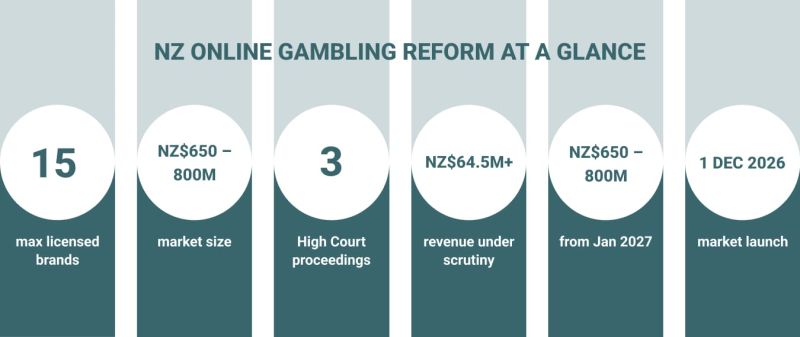
Consolidation favours operators with capital and existing NZ revenue: SkyCity, bet365, Super Group and Entain, which alone is targeting three licences. Against a Jarden-forecast revenue pool of NZ$650 million split among at most 15 brands, most of the grey market's long tail is expected to exit rather than bid.
Past operations face a legal test. By April 2026, three coordinated High Court proceedings were under way in Auckland against bet365, Super Group and SkyCity (via its Malta-based Silvereye platform), seeking to recover player losses from offshore-facing operations. The SkyCity class action covers losses from February 2020 to February 2026, a window reported to span at least NZ$64.5 million in online revenue, while bet365 is contesting the jurisdiction of the New Zealand courts. The claims parallel a recent EU Court of Justice ruling that a Malta licence does not shield operators from restitution claims in markets where their activity was prohibited. The outcomes could affect auction pricing and operators' appetite for the market, although SkyCity has continued to pursue a licence.
The fiscal case depends on channelisation. If a NZ$700–800 million market moves onshore at a combined effective rate above 30%, the Crown collects far more than the NZ$62.5 million the offshore duty yielded in its first full year. The risk scenario: if 15 platforms with strict limits feel too restrictive, some players drift back to illegal sites, which is exactly what the three-year review is designed to measure.
For players, the real start date is 1 December 2026: operators that have not applied for a licence must leave, applicants may keep going without advertising, and the countdown to the June 2027 cut-off begins.

Related articles
New Casinos
Welcome Bonus
Welcome bonus: max. 200% up to NZ$5,000 + 150 FS + 1 Bonus Game

Welcome Bonus
Welcome Bonus: max. 100% up to NZ$10,000 + 500 Free Spins
Welcome Bonus
Welcome bonus: max. 100% up to 32,000 NZD + 350 FS

Welcome Bonus
Welcome bonus: NZ$5,200 + 150 free spins

Welcome Bonus
Max. 150% up to NZ$20,000 + 500 Free Spins

Welcome Bonus
Welcome Bonus: max. 100% up to NZ$2,100 + 60 FS
New